Reference
Configuration
DeltaGlider Proxy is configured via a YAML file and/or environment variables (DGP_* prefix). Environment variables always take precedence over file contents.
YAML is the only supported format. TOML support was removed in v1.4.1: a .toml config — whether set via DGP_CONFIG or found on the default search path — makes the proxy fail at startup with TOML configs are no longer supported (removed in v1.4.1). If you still carry a TOML config, run deltaglider_proxy config migrate on v1.4.0 to convert it, then point the server at the YAML file before upgrading. See How to upgrade the proxy.
Table of contents#
- YAML layout
- Shorthands
- Config-file search order
- Server / Advanced
- Delta engine
- Storage backend
- Access — authentication
- Access — IAM mode
- Admission chain
- Security
- TLS
- Config sync
- Multi-backend routing
- Bucket policies
- Lifecycle rules
- Event delivery
- Encryption at rest
- CLI subcommands
- Full example
- Environment variable registry
YAML layout#
The canonical YAML has four optional top-level sections:
# deltaglider_proxy.yaml

admission:   # pre-auth request gating (deny / reject / allow-anonymous)
  blocks: [...]

access:      # SigV4 credentials + iam_mode selector
  iam_mode: gui             # gui (default) or declarative
  access_key_id: admin
  secret_access_key: changeme

storage:     # backend(s) + per-bucket overrides
  s3: https://s3.example.com
  buckets: {...}

advanced:    # process-level tunables
  listen_addr: "0.0.0.0:9000"
  cache_size_mb: 2048
  log_level: deltaglider_proxy=info
Every section is optional. Fields equal to their default are omitted from canonical exports (GET /api/admin/config/export), keeping GitOps diffs minimal.
The flat (pre-Phase-3) shape — root-level listen_addr:, backend:, etc. — still loads unchanged. Mixing the two shapes in one document is a hard parse error naming the conflicting keys.
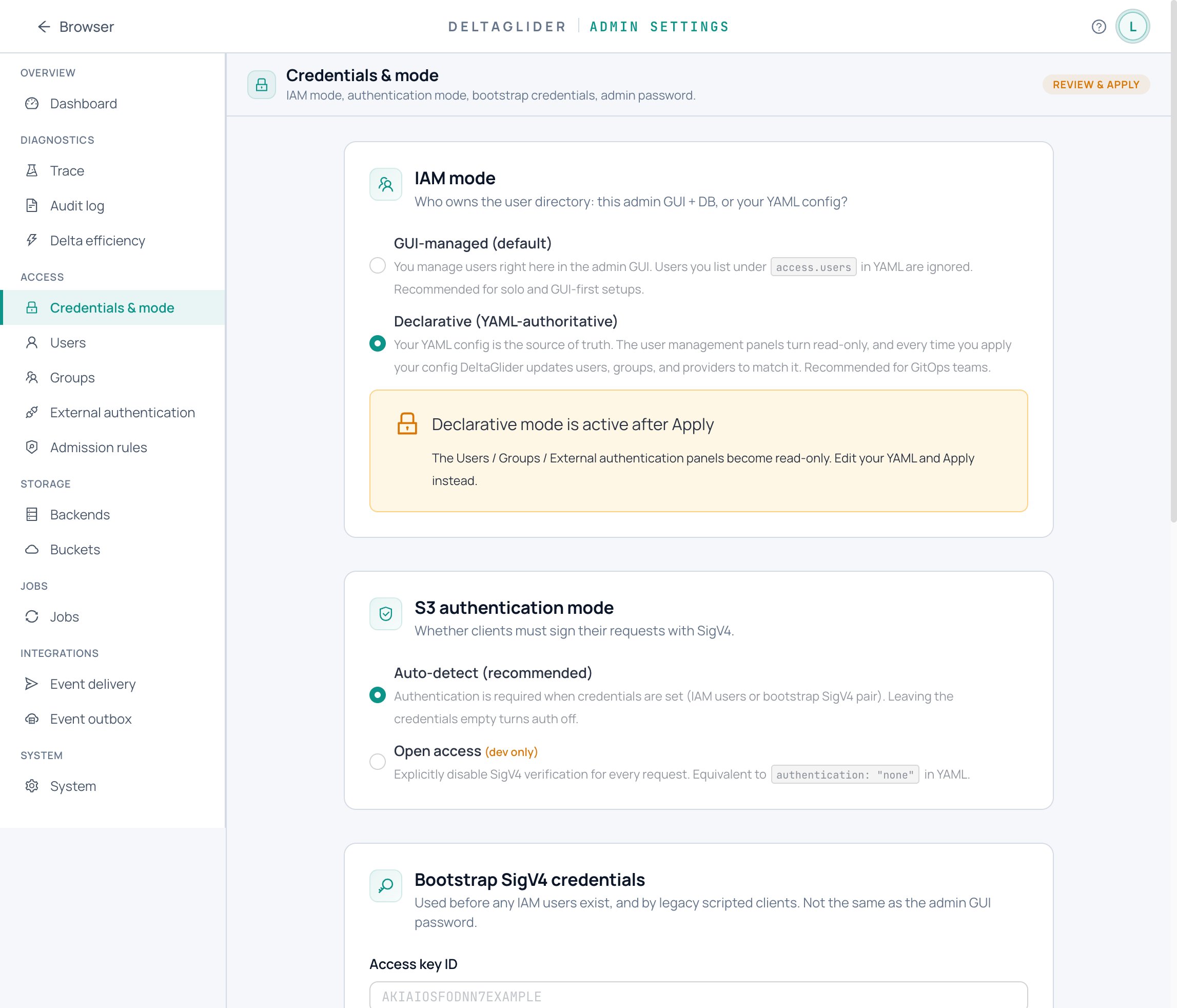
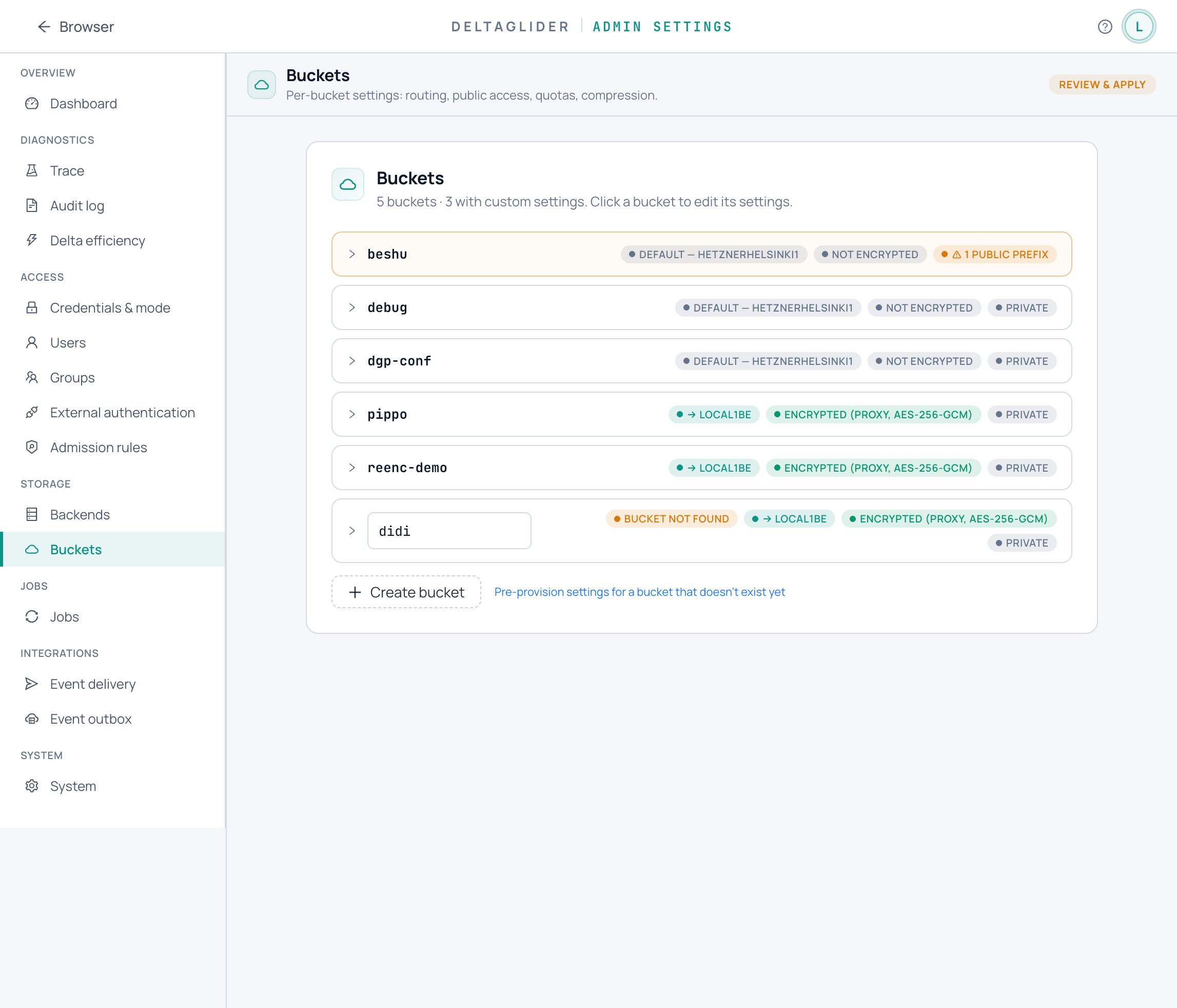
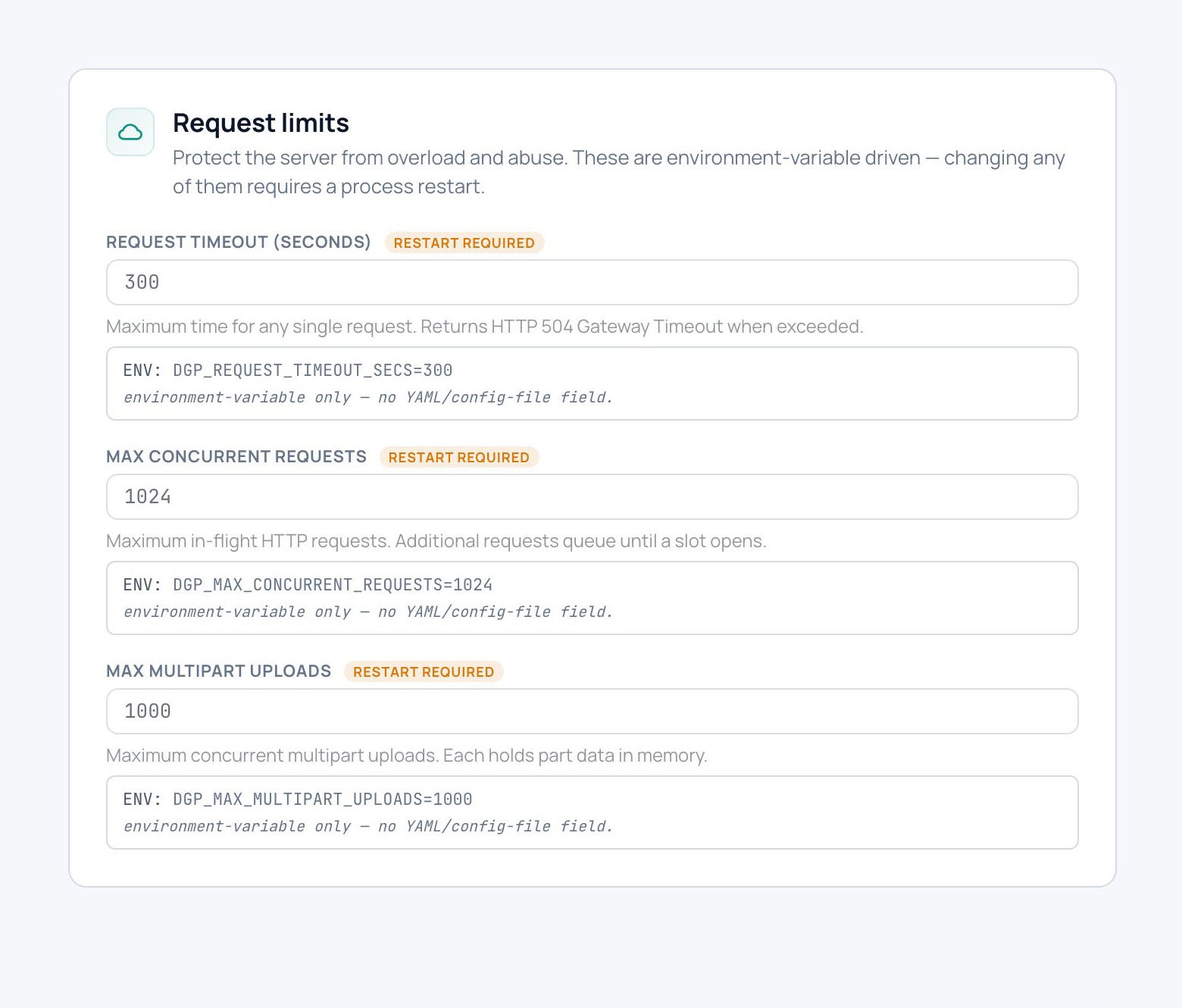
The same document is editable from the admin UI. The form keeps section ownership visible and surfaces each field's YAML path on hover; environment-driven fields note their DGP_* variable inline in the help text.
Shorthands#
Three operator-authoring shorthands expand at load time into their canonical forms.
Storage shorthand — single backend#
storage:
  s3: https://s3.example.com       # expands to backend: { type: s3, endpoint: ... }
  region: eu-central-1             # optional
  access_key_id: admin             # optional
  secret_access_key: changeme      # optional
  force_path_style: true           # optional
or
storage:
  filesystem: /var/lib/deltaglider
Only one of backend: / s3: / filesystem: may be set. Companion fields (region, access_key_id, etc.) apply only to s3:.
Bucket public: true#
storage:
  buckets:
    docs-site:
      public: true           # shorthand for public_prefixes: [""]
The canonical exporter collapses public_prefixes: [""] back to public: true when unambiguous. The GUI "Public read" toggle maps 1:1 to the YAML.
Mixing public: true and a non-empty public_prefixes is a hard error.
Config-file search order#
Config::resolve_config_path returns the first match from:
DGP_CONFIGenv var (returned unconditionally — if set, the path is used even when the file doesn't yet exist)../deltaglider_proxy.yaml./deltaglider_proxy.yml./deltaglider_proxy.toml(tripwire — startup fails)/etc/deltaglider_proxy/config.yaml/etc/deltaglider_proxy/config.yml/etc/deltaglider_proxy/config.toml(tripwire — startup fails)
The .toml entries are tripwires, not loadable formats: a leftover TOML config matched by the search (with no YAML earlier in the order) stops startup with an actionable error rather than being silently ignored.
CLI flags (--config <path>, --listen <addr>) take precedence over all of the above; env vars take precedence over file contents.
Server / Advanced#
Process-level knobs. In sectioned YAML these live under advanced:.
listen_addr#
HTTP listen address.
| Env var | DGP_LISTEN_ADDR |
| YAML | advanced.listen_addr (sectioned) or root listen_addr: (flat) |
| Default | 0.0.0.0:9000 |
| Hot-reload | No (restart required) |
advanced:
  listen_addr: "0.0.0.0:8080"
log_level#
Tracing filter string (tracing-subscriber syntax). Overridden by RUST_LOG if set. Changeable at runtime via the admin GUI (Settings → System → Logging card), which hot-reloads the filter through the apply pipeline.
Resolution order at startup: RUST_LOG > DGP_LOG_LEVEL > advanced.log_level in file > --verbose CLI flag (sets trace) > default.
| Env var | DGP_LOG_LEVEL |
| YAML | advanced.log_level |
| Default | deltaglider_proxy=debug,tower_http=debug |
| Hot-reload | Yes (via admin GUI or config apply) |
advanced:
  log_level: deltaglider_proxy=info,tower_http=warn
Structured logs and the in-GUI log ring#
Three env-only knobs control log output and the admin System logs viewer (see View live logs):
| Env var | Default | Effect |
|---|---|---|
DGP_LOG_FORMAT | text | json emits one JSON object per stdout line — jq-greppable by client IP, bucket, action. Startup-only. |
DGP_LOG_RING_SIZE | 2000 | Capacity of the in-memory operational-log ring behind the admin Logs viewer. |
DGP_LOG_RING_LEVEL | info | Minimum severity captured into the ring/live-tail stream, independent of DGP_LOG_LEVEL. |
The ring is per-instance, in-memory, and bounded — a triage convenience. Point a log shipper at the DGP_LOG_FORMAT=json stdout stream for retention and aggregation.
request_timeout_secs#
Per-request deadline (HTTP 504 when exceeded).
| Env var | DGP_REQUEST_TIMEOUT_SECS |
| Default | 300 (5 minutes) |
| Hot-reload | No |
max_concurrent_requests#
Global tower ConcurrencyLimit. Requests beyond this queue.
| Env var | DGP_MAX_CONCURRENT_REQUESTS |
| Default | 1024 |
| Hot-reload | No |
max_multipart_uploads#
Concurrent multipart uploads cap. Each upload holds part data in memory.
| Env var | DGP_MAX_MULTIPART_UPLOADS |
| Default | 1000 |
| Hot-reload | No |
blocking_threads#
Tokio blocking thread-pool size. Controls how many concurrent CPU-bound ops (xdelta3 subprocesses) can run.
| Env var | DGP_BLOCKING_THREADS |
| YAML | advanced.blocking_threads |
| Default | tokio default (512) |
| Hot-reload | No |
debug_headers#
Expose debug/fingerprinting headers (x-amz-storage-type, x-deltaglider-cache). Disable in production to prevent server fingerprinting.
| Env var | DGP_DEBUG_HEADERS |
| Default | false |
| Hot-reload | No |
cors_permissive#
Enable permissive CORS for cross-origin admin access (dev only — opens the door to CSRF against session-cookie endpoints).
| Env var | DGP_CORS_PERMISSIVE |
| Default | false |
| Hot-reload | No |
config#
Path to the config file.
| Env var | DGP_CONFIG |
| Default | Auto-detect (search list above) |
When DGP_CONFIG is set, the path is returned unconditionally — a missing file there is NOT silently replaced by the default search list. This prevents the admin API from persisting to a CWD-relative file the operator never asked for.
Delta engine#
max_delta_ratio#
Store an object as a delta only if delta_size / original_size is below this ratio. Lower = more aggressive savings; higher = more files kept as deltas.
| Env var | DGP_MAX_DELTA_RATIO |
| YAML | advanced.max_delta_ratio |
| Default | 0.75 |
| Hot-reload | Yes |
max_object_size#
Maximum object size in bytes. Enforced as the HTTP request body limit, so it caps uploads for both delta and passthrough objects; it is also the per-object ceiling for delta processing (xdelta3 memory constraint) and sizes the multipart upload budget. 0 rejects all uploads (startup warning).
| Env var | DGP_MAX_OBJECT_SIZE |
| Default | 104857600 (100 MB) |
| Hot-reload | Yes |
cache_size_mb#
In-memory reference cache size in MB. Recommend 1024+ MB for production. Undersized caches (<1024 MB) emit a startup warning.
| Env var | DGP_CACHE_MB |
| YAML | advanced.cache_size_mb |
| Default | 100 |
| Hot-reload | No |
metadata_cache_mb#
In-memory FileMetadata cache size in MB. Set to 0 to disable. Budget: ~125K-150K entries at 50 MB. 10-minute TTL.
| Env var | DGP_METADATA_CACHE_MB |
| YAML | advanced.metadata_cache_mb |
| Default | 50 |
| Hot-reload | No |
codec_concurrency#
Maximum concurrent xdelta3 subprocesses. Auto-detected as num_cpus * 4 (min 16).
| Env var | DGP_CODEC_CONCURRENCY |
| YAML | advanced.codec_concurrency |
| Default | num_cpus * 4 (min 16) |
| Hot-reload | Yes (triggers engine rebuild) |
codec_timeout_secs#
Maximum time for an xdelta3 subprocess. Hung processes are killed after this.
| Env var | DGP_CODEC_TIMEOUT_SECS |
| Default | 60 |
| Hot-reload | No |
Storage backend#
Filesystem backend#
Local filesystem. Activated by setting DGP_DATA_DIR or a backend: block with type = "filesystem".
data_dir#
| Env var | DGP_DATA_DIR |
| YAML (shorthand) | storage.filesystem: <path> |
| YAML (canonical) | storage.backend.path |
| Default | ./data |
| Hot-reload | Yes (triggers engine rebuild) |
# Shorthand
storage:
  filesystem: /var/lib/deltaglider

# Canonical (equivalent)
storage:
  backend:
    type: filesystem
    path: /var/lib/deltaglider
Paths containing .. components are rejected at load time.
S3 backend#
AWS S3 / MinIO / Hetzner / Backblaze / any S3-compatible service. Activated by setting DGP_S3_ENDPOINT or a backend: block with type = "s3".
endpoint / region / force_path_style / access_key_id / secret_access_key#
| Field | Env var | YAML shorthand | YAML canonical | Default |
|---|---|---|---|---|
| endpoint | DGP_S3_ENDPOINT | storage.s3: <url> | storage.backend.endpoint | — (AWS default) |
| region | DGP_S3_REGION | storage.region | storage.backend.region | us-east-1 |
| force_path_style | DGP_S3_PATH_STYLE | storage.force_path_style | storage.backend.force_path_style | true |
| access_key_id | DGP_BE_AWS_ACCESS_KEY_ID | storage.access_key_id | storage.backend.access_key_id | — |
| secret_access_key | DGP_BE_AWS_SECRET_ACCESS_KEY | storage.secret_access_key | storage.backend.secret_access_key | — |
# Shorthand
storage:
  s3: https://hel1.your-objectstorage.com
  region: hel1
  access_key_id: AKIAIOSFODNN7EXAMPLE
  secret_access_key: wJalrXUtnFEMI/K7MDENG/bPxRfiCYEXAMPLEKEY

# Canonical
storage:
  backend:
    type: s3
    endpoint: https://hel1.your-objectstorage.com
    region: hel1
    force_path_style: true
    access_key_id: AKIAIOSFODNN7EXAMPLE
    secret_access_key: wJalrXUtnFEMI/K7MDENG/bPxRfiCYEXAMPLEKEY
Endpoint URLs must start with http:// or https:// (scheme-less values rejected at load time).
Access — authentication#
The proxy refuses to start without credentials unless you set authentication = "none".
authentication#
Explicit auth-mode selector. Absent = auto-detect from credentials; "none" = open access (dev only).
| Env var | DGP_AUTHENTICATION |
| YAML | access.authentication |
| Default | — (auto-detect; fatal error if absent AND no credentials) |
| Hot-reload | No |
access_key_id / secret_access_key#
Proxy-level SigV4 credentials (the "bootstrap admin" credential pair).
| Env vars | DGP_ACCESS_KEY_ID / DGP_SECRET_ACCESS_KEY |
| YAML | access.access_key_id / access.secret_access_key |
| Default | None |
| Hot-reload | Yes |
access:
  access_key_id: admin
  secret_access_key: changeme
bootstrap_password_hash#
Bcrypt hash of the bootstrap password (encrypts the IAM config DB, signs session cookies, gates admin GUI access in bootstrap mode). Auto-generated on first run. Accepts base64-encoded hashes to avoid $ escaping in Docker/env vars.
| Env var | DGP_BOOTSTRAP_PASSWORD_HASH (legacy alias: DGP_ADMIN_PASSWORD_HASH) |
| YAML | advanced.bootstrap_password_hash (treated as an infra secret — stripped by canonical exports) |
| Default | Auto-generated on first run |
DGP_BOOTSTRAP_PASSWORD#
Plaintext bootstrap password for the config apply / admission trace admin CLI commands (they authenticate via this env var; argv is avoided because it leaks via ps). Not read by the server itself.
| Env var | DGP_BOOTSTRAP_PASSWORD |
| Consumer | Admin CLI (deltaglider_proxy config apply, ... admission trace) |
Access — IAM mode#
The access.iam_mode YAML selector controls where IAM state (users, groups, OAuth providers, mapping rules) lives. Orthogonal to the authentication selector.
| Mode | Meaning |
|---|---|
gui (default) | Encrypted SQLCipher DB is source of truth. Admin GUI + admin API mutate it. YAML access.* carries only the legacy SigV4 pair + authentication selector. |
declarative | YAML access.iam_users, iam_groups, auth_providers, and group_mapping_rules are authoritative. Admin API IAM mutation routes (POST/PUT/PATCH/DELETE on /users, /groups, /ext-auth/*, /migrate, backup import) return 403 { "error": "iam_declarative" }. Read routes stay accessible. |
access:
  iam_mode: declarative
Mode transitions are audit-logged at warn level on the deltaglider_proxy::config target. In declarative mode, every /config/apply or section-PUT on access runs a dry validation + diff, then reconciles the encrypted config DB to YAML in one SQLite transaction. Creates, updates, and deletes emit iam_reconcile_* audit entries.
The initial gui → declarative flip is guarded: if YAML contains no users or groups while the DB is non-empty, apply fails instead of wiping IAM by accident. To seed GitOps YAML from an existing DB, use GET /_/api/admin/config/declarative-iam-export; see Declarative IAM for the full workflow.
Admission chain#
Operator-authored pre-auth request gating. Blocks are evaluated top-to-bottom; first match wins. Operator blocks fire before synthesized public-prefix blocks derived from storage.buckets[*].public_prefixes.
admission:
  blocks:
    - name: deny-known-bad-ips
      match:
        source_ip_list:
          - "198.51.100.17"
          - "198.51.100.0/24"
      action: deny

    - name: maintenance-mode
      match: {}              # empty = match every request
      action:
        type: reject
        status: 503
        message: "Planned maintenance — back at 18:00 UTC."

    - name: allow-public-zips
      match:
        method: [GET, HEAD]
        bucket: releases
        path_glob: "*.zip"
      action: allow-anonymous
Block fields#
| Field | Type | Notes |
|---|---|---|
name | string (required) | 1-128 chars, [A-Za-z0-9_:.-]. Must be unique across the chain. public-prefix:* is reserved for synthesized blocks. |
match | object (default {}) | AND-combined predicates. Empty {} fires on every request. |
match.method | [string] | HTTP methods: GET HEAD PUT POST DELETE PATCH OPTIONS. Case-insensitive on parse. |
match.source_ip | IP | Exact match. Mutually exclusive with source_ip_list. |
match.source_ip_list | [IP | CIDR] | Accepts bare IPs (promoted to /32 or /128) and CIDRs. Cap: 4096 entries. |
match.bucket | string | Target bucket (lowercased on parse). |
match.path_glob | string | Glob against the full key: *.zip, releases/**, docs/readme.md. |
match.authenticated | bool | true = only authenticated; false = only anonymous; absent = either. |
match.config_flag | string | Named flag. Registry is not yet live — maintenance_mode is recognised but always evaluates false; a warning fires at chain-build time. |
action | string | object (required) | Simple: allow-anonymous, deny, continue. Tagged: { type: reject, status: <4xx|5xx>, message?: <string> }. |
continue is an explicit terminal that falls through to authentication — useful as the final block for diagnostic visibility in trace output.
Round-trip#
Operator-authored source_ip_list entries round-trip verbatim (bare IPs stay bare, CIDRs stay CIDRs) so GitOps diffs don't flip on every apply.
The admin GUI's Admission page (/_/admin/access/admission) is the authoring surface. Synthesized public-prefix:* blocks appear read-only below the operator list; edit them via Storage → Buckets instead.
Security#
trust_proxy_headers#
Trust X-Forwarded-For / X-Real-IP for rate limiting and aws:SourceIp IAM conditions. Disable if the proxy is internet-facing without a reverse proxy.
| Env var | DGP_TRUST_PROXY_HEADERS |
| Default | false (secure-by-default) |
| Hot-reload | No |
Production-critical behind a reverse proxy. If the proxy sits behind Coolify, Traefik, nginx, Caddy, or an ALB and this stays false, every request appears to come from the proxy's own IP — so all clients collapse onto a single shared rate-limit bucket, and one busy client can lock out everyone else with 503 SlowDown. Set it to true whenever a trusted reverse proxy injects X-Forwarded-For / X-Real-IP. The save-time config advisories (see Config advisories) flag the rate-limit-on + trust-off combination for you. Leave it false only when the proxy is directly internet-facing (otherwise a client could spoof the headers).
session_ttl_hours#
Admin GUI session TTL.
| Env var | DGP_SESSION_TTL_HOURS |
| Default | 4 |
| Hot-reload | No |
clock_skew_seconds#
SigV4 clock skew tolerance.
| Env var | DGP_CLOCK_SKEW_SECONDS |
| Default | 300 (5 min) |
| Hot-reload | No |
replay_window_secs#
SigV4 replay detection window. A request whose signature was already seen within this many seconds is treated as a replay.
- Mutating methods (PUT/POST/DELETE/…) are rejected with
400 Request replay detected. - Idempotent reads (GET/HEAD) are tolerated: a duplicate within the window is served normally rather than rejected. This is deliberate — boto3/botocore emit byte-identical SigV4 signatures for the same request issued (or auto-retried) within one signing second, because SigV4 timestamps have 1-second granularity. A replayed read just re-reads the same bytes, so there is no double-effect to guard against. The signature still stays in the cache, so a captured read signature can't be replayed past the window.
- Presigned URLs are exempt entirely (they are designed to be reused for their whole expiry).
- A replay rejection is not an authentication failure — the signature is valid — so it is audited as
replay_rejectedand does not count toward the per-IP brute-force lockout.
Set DGP_REPLAY_WINDOW_SECS=0 to disable replay rejection entirely (the window never matches). Useful in CI, or as an escape hatch if a client clusters mutations tighter than the default tolerates.
| Env var | DGP_REPLAY_WINDOW_SECS |
| Default | 2 |
| Hot-reload | No |
secure_cookies#
Require HTTPS for admin session cookies (Secure flag).
| Env var | DGP_SECURE_COOKIES |
| Default | true |
| Hot-reload | No |
Config advisories#
At save time — in the admin Apply dialog and in config apply / config lint — the proxy runs a set of cross-field checks and surfaces warnings for combinations that are individually valid but suspicious together. They never block a save; they flag footguns before they reach production. Current rules:
| Advisory | Fires when | Why it matters |
|---|---|---|
| Shared rate-limit bucket | Rate limiting is enabled but trust_proxy_headers is false | Behind a reverse proxy, every client collapses onto the proxy's IP and one shared bucket — one client can lock out all others. |
| Stale IAM template | A permission resource uses a bare ${username} instead of ${iam:username} | The bare form is not substituted, so the rule matches nothing and silently denies the user. |
| Frozen bucket quota | A bucket's quota_bytes is 0 | A zero quota rejects all writes to that bucket. |
| Redundant public prefix | public_prefixes are set while authentication: none | Auth is already open, so the public-prefix rules add nothing. |
Rate limiting#
Per-IP brute-force protection for auth endpoints. See Rate limits and concurrency for the full model.
| Setting | Env var | Default |
|---|---|---|
| Max failures before lockout | DGP_RATE_LIMIT_MAX_ATTEMPTS | 100 |
| Rolling window | DGP_RATE_LIMIT_WINDOW_SECS | 300 (5 min) |
| Lockout duration | DGP_RATE_LIMIT_LOCKOUT_SECS | 600 (10 min) |
TLS#
When enabled, both the S3 API and admin GUI serve HTTPS on the single listener.
advanced:
  tls:
    enabled: true
    cert_path: /etc/ssl/certs/proxy.pem
    key_path: /etc/ssl/private/proxy-key.pem
| Field | Env var | YAML | Default |
|---|---|---|---|
| enabled | DGP_TLS_ENABLED | advanced.tls.enabled | false |
| cert_path | DGP_TLS_CERT | advanced.tls.cert_path | Auto-generate self-signed |
| key_path | DGP_TLS_KEY | advanced.tls.key_path | Auto-generate |
When cert_path and key_path are both absent, a self-signed certificate is generated on startup.
TLS is bound once at startup — a tls.* change applied at runtime (admin API / config apply) is persisted but does not take effect until you restart the proxy. The apply response flags this with a requires_restart warning.
Config sync#
Multi-instance coordination via S3. When enabled, the shared bucket does three things: the encrypted config DB file is replicated to it (IAM sync); it hosts the per-rule replication leader leases (_dgp/leases/replication/…, automatic failover); and setting it activates the boot-time conditional-write validation — of this bucket AND of every named S3 backend hosting client-writable buckets (non-CAS → the proxy refuses to start; see backend capability validation).
| Env var | DGP_CONFIG_SYNC_BUCKET |
| YAML | advanced.config_sync_bucket |
| Default | None (disabled) |
advanced:
  config_sync_bucket: dgp-iam-sync
Sync uses the same S3 credentials as the storage backend (DGP_BE_AWS_*) and only works when the storage backend is S3 (not filesystem). On every IAM mutation, the DB is uploaded to s3://<bucket>/.deltaglider/config.db; readers poll the S3 ETag every 5 minutes and download on change.
The sync poller starts once at boot — enabling or changing config_sync_bucket at runtime is persisted but does not take effect until restart (the apply response flags this with a requires_restart warning).
Multi-backend routing#
Route different buckets to different storage backends. When backends is non-empty, the legacy single backend is ignored at runtime.
storage:
  default_backend: hetzner-fsn1
  backends:
    - name: hetzner-fsn1
      type: s3
      endpoint: https://fsn1.your-objectstorage.com
      region: fsn1
      access_key_id: HETZNER_KEY
      secret_access_key: HETZNER_SECRET
    - name: aws-dr
      type: s3
      endpoint: https://s3.eu-west-1.amazonaws.com
      region: eu-west-1
      access_key_id: AWS_KEY
      secret_access_key: AWS_SECRET
    - name: local-disk
      type: filesystem
      path: /var/lib/dgp-local
  buckets:
    db-archive:
      backend: hetzner-fsn1
      alias: acme-db-archive-prod
Backends can be added/removed via the admin GUI (Storage → Backends) without restart. default_backend is validated against the backends list at load time — invalid references are cleared with a warning.
Bucket policies#
Per-bucket overrides. All fields optional.
storage:
  buckets:
    releases:
      compression: true
      max_delta_ratio: 0.9
      backend: hetzner-fsn1
      alias: acme-prod-releases-fsn1
      quota_bytes: 10737418240    # 10 GiB
    downloads:
      public_prefixes: ["public/"]
    docs-site:
      public: true                # shorthand for public_prefixes: [""]
    releases-mirror:
      backend: b2-archive
      replication_target_only: true
| Field | Type | Default | Description |
|---|---|---|---|
compression | bool | global | Enable/disable delta compression for this bucket |
max_delta_ratio | float (0-1) | global | Override the delta-keep threshold |
backend | string | default | Route to a named backend from storage.backends |
alias | string | same as bucket name | Virtual → real bucket name mapping on the backend |
public_prefixes | [string] | [] | Anonymous read (GET/HEAD/LIST) scoped to these key prefixes |
public | bool | — | Shorthand for public_prefixes: [""] (entire bucket public) |
quota_bytes | u64 | — | Soft storage quota (may overshoot by up to 5 minutes of writes); 0 = freeze bucket |
replication_target_only | bool | false | Client writes return 403; replication is the only writer. Makes a non-CAS backend (e.g. Backblaze B2) a safe mirror — see backend capability validation |
Public prefixes#
When public_prefixes (or public: true) is set, anonymous users can GET, HEAD, and LIST objects under the prefix. Writes always require authentication. Use trailing / for directory-aligned matching ("public/" matches public/installer.zip but not publicity/). The empty string "" makes the entire bucket public (logged as a warning). Prefixes containing .., null bytes, or // are rejected. The proxy synthesizes public-prefix:<bucket> admission blocks from this config.
Lifecycle rules#
Expiration (delete) and transition/archive rules live under storage.lifecycle. Disabled by default; every delete and copy goes through the DeltaGlider engine.
storage:
  lifecycle:
    enabled: false
    tick_interval: "1h"
    max_failures_retained: 100
    rules:
      - name: expire-nightly-dumps
        enabled: false
        bucket: db-archive
        prefix: "nightly/"
        action: delete
        expire_after: "90d"
        include_globs: ["nightly/**/*.dump"]
        exclude_globs: [".deltaglider/**", "nightly/golden/**"]
Use POST /_/api/admin/jobs/lifecycle:<name>/preview (or the Preview button on the Jobs screen) before enabling a rule. See Lifecycle Rules for API details, skip rules, and limitations.
Event delivery#
Durable object mutation events are always appended to the encrypted config DB
when it is available. HTTP delivery is disabled by default; enabling
advanced.event_delivery starts a background dispatcher that POSTs each event
to every configured webhook endpoint.
advanced:
  event_delivery:
    enabled: true
    webhook_url: "https://events.example.com/deltaglider"
    webhook_urls:
      - "https://audit.example.com/deltaglider"
    webhook_headers:
      authorization: "Bearer redacted-token"
      x-dgp-env: "prod"
    tick_interval: "10s"
    batch_size: 50
    request_timeout: "5s"
    max_attempts: 8
    retry_base: "5s"
    retry_max: "5m"
    stale_claim_after: "60s"
    delivered_retention: "24h"
    delivered_max_rows: 10000
    prune_batch: 100
webhook_url is the single-endpoint shortcut. webhook_urls adds fan-out
endpoints, and webhook_headers are attached to every delivery request. A row
is marked delivered only after all endpoints return 2xx; failed rows back off
and can be requeued from the admin API/UI. See Event log
for payload and diagnostics details.
Slack format#
Set format: slack to render each event as a Slack message (Block Kit + text
fallback) instead of the raw {schema,event} envelope. Two modes — pick one:
advanced:
  event_delivery:
    enabled: true
    format: slack
    # Incoming Webhook mode (simplest, single channel):
    webhook_url: "https://hooks.slack.com/services/T000/B000/XXXX"
    slack_username: "DeltaGlider"        # optional cosmetic override
    slack_icon_emoji: ":package:"        # optional
    # Bot-token mode (multi-channel + @mentions) — set these INSTEAD of webhook_url:
    # slack_bot_token: "xoxb-..."        # needs chat:write + chat:write.public scopes
    # slack_channel: "C0123456"          # channel id or #name (required in this mode)
    # Scope what gets posted:
    slack_notify_kinds: ["ObjectCreated"]   # add ObjectDeleted, etc.
    slack_include_globs: ["firmware/**"]    # empty = all user objects
    slack_exclude_globs: ["**/*.tmp"]       # exclude wins over include
    # Per-bucket/prefix routing (bot-token mode only):
    slack_routes:
      - name: "Releases → #ci"
        bucket: releases
        prefix_globs: ["firmware/**"]    # empty = any key in the bucket
        channel: "C_CI"
| Key | Notes |
|---|---|
format | raw (default) or slack. |
slack_bot_token | xoxb-… Slack Web API token. Secret — masked on export, preserved on an untouched round-trip. Selects bot-token mode (chat.postMessage). |
slack_channel | Target channel (C0123 or #name). Required in bot-token mode; ignored for Incoming Webhook URLs (each URL is bound to one channel by Slack). |
slack_username / slack_icon_emoji | Cosmetic sender overrides (Incoming Webhook mode). |
slack_notify_kinds | Which event kinds post. Default ["ObjectCreated"]. |
slack_include_globs / slack_exclude_globs | Key-glob pre-filter (exclude wins). |
slack_routes | Per-bucket / per-prefix → channel routing (bot-token mode only). When non-empty, an eligible event posts to every matching route; slack_channel is the fallback for events matching no route. |
The whole thing is editable from the admin GUI at Integrations → Event delivery (toggle the format to Slack). See Event log for delivery semantics.
Encryption at rest#
Per-backend encryption with four modes: none, aes256-gcm-proxy, sse-kms, sse-s3. Each backend carries its own encryption block — operators can mix (e.g. SSE-KMS for the production backend, plaintext for a public-CDN backend) without sharing a single blast-radius key.
YAML — named-backends path:
storage:
  backends:
    - name: hetzner-fsn1
      type: s3
      # endpoint, region, credentials …
      encryption:
        mode: aes256-gcm-proxy
        key: "${env:DGP_BACKEND_HETZNER_FSN1_ENCRYPTION_KEY}"
        key_id: hetzner-2026-06   # optional; derived from SHA-256(name + key) when absent
    - name: aws-dr
      type: s3
      # region, credentials …
      encryption:
        mode: sse-kms
        kms_key_id: arn:aws:kms:eu-west-1:123456789012:key/abcd-ef01
        bucket_key_enabled: true
YAML — singleton-backend path (backends: empty):
storage:
  backend: { ... }
  backend_encryption:
    mode: aes256-gcm-proxy
    key: "${env:DGP_ENCRYPTION_KEY}"
Env vars (infra secrets — these are the recommended key source; every key / kms_key_id field in YAML is stripped by canonical exports):
| Env var | Binds to |
|---|---|
DGP_ENCRYPTION_KEY | backend_encryption.key (singleton path) |
DGP_BACKEND_<NAME>_ENCRYPTION_KEY | backends[name=<NAME>].encryption.key |
DGP_SSE_KMS_KEY_ID | backend_encryption.kms_key_id (singleton SSE-KMS) |
DGP_BACKEND_<NAME>_SSE_KMS_KEY_ID | named SSE-KMS override |
Name normalisation: <NAME> is uppercased; - and . become _ (so hetzner-fsn1 → DGP_BACKEND_HETZNER_FSN1_ENCRYPTION_KEY).
Defaults: absent encryption block → mode: none (plaintext).
Formats: key / legacy_key are 64-char lowercase hex (256 bits). kms_key_id is a KMS ARN or alias. key_id (optional) must match [A-Za-z0-9_.-]{1,64} (S3 user-metadata header-safe).
Rotation within a single mode is not automated — use the legacy_key / legacy_key_id shim fields (decrypt-only, for proxy→native transitions) or copy objects to a new backend. See the encryption reference for the full wire format, key-id mismatch mechanics, and the shim lifecycle.
CLI subcommands#
See Command-line tools.
Full example#
A kitchen-sink YAML covering every top-level section. Fields omitted here inherit their defaults.
# deltaglider_proxy.yaml

# Operator-authored admission chain (pre-auth gating)
admission:
  blocks:
    - name: deny-known-bad-ips
      match:
        source_ip_list: ["198.51.100.0/24"]
      action: deny

    - name: allow-public-zips
      match:
        method: [GET, HEAD]
        bucket: releases
        path_glob: "*.zip"
      action: allow-anonymous

# SigV4 credentials + IAM mode
access:
  iam_mode: gui               # or declarative
  access_key_id: admin
  secret_access_key: changeme

# Backends + per-bucket overrides
storage:
  default_backend: hetzner-fsn1
  backends:
    - name: hetzner-fsn1
      type: s3
      endpoint: https://fsn1.your-objectstorage.com
      region: fsn1
      force_path_style: true
      access_key_id: HETZNER_KEY
      secret_access_key: HETZNER_SECRET
    - name: aws-dr
      type: s3
      endpoint: https://s3.eu-west-1.amazonaws.com
      region: eu-west-1
      access_key_id: AWS_KEY
      secret_access_key: AWS_SECRET
  buckets:
    releases:
      backend: hetzner-fsn1
      compression: true
    db-archive:
      backend: aws-dr
      alias: acme-db-archive-prod
      compression: false
    downloads:
      public_prefixes: ["public/"]

# Process-level tunables
advanced:
  listen_addr: "0.0.0.0:9000"
  log_level: deltaglider_proxy=info,tower_http=warn
  max_delta_ratio: 0.75
  cache_size_mb: 2048
  metadata_cache_mb: 100
  codec_concurrency: 32
  config_sync_bucket: dgp-iam-sync
  event_delivery:
    enabled: true
    webhook_urls:
      - "https://audit.example.com/deltaglider"
    webhook_headers:
      authorization: "Bearer redacted-token"
  tls:
    enabled: true
    cert_path: /etc/ssl/certs/proxy.pem
    key_path: /etc/ssl/private/proxy-key.pem
Equivalent environment variables for container deployments:
DGP_LISTEN_ADDR=0.0.0.0:9000
DGP_MAX_DELTA_RATIO=0.75
DGP_MAX_OBJECT_SIZE=104857600
DGP_CACHE_MB=2048
DGP_METADATA_CACHE_MB=100
DGP_CODEC_CONCURRENCY=32
DGP_LOG_LEVEL=deltaglider_proxy=info,tower_http=warn
DGP_ACCESS_KEY_ID=admin
DGP_SECRET_ACCESS_KEY=changeme
DGP_BOOTSTRAP_PASSWORD_HASH=JDJiJDEyJENYbDVPRm84bDg2...
DGP_CONFIG_SYNC_BUCKET=dgp-iam-sync
DGP_S3_ENDPOINT=https://fsn1.your-objectstorage.com
DGP_S3_REGION=fsn1
DGP_S3_PATH_STYLE=true
DGP_BE_AWS_ACCESS_KEY_ID=HETZNER_KEY
DGP_BE_AWS_SECRET_ACCESS_KEY=HETZNER_SECRET
DGP_TLS_ENABLED=true
DGP_TLS_CERT=/etc/ssl/certs/proxy.pem
DGP_TLS_KEY=/etc/ssl/private/proxy-key.pem
Environment variable registry#
Exhaustive list of every DGP_* variable the server reads. The unit test test_registry_completeness in src/config/mod.rs enforces that this list and ENV_VAR_REGISTRY stay in sync.
Server / Advanced#
| Variable | Default | Description |
|---|---|---|
DGP_CONFIG | auto | Path to the YAML config file (.yaml / .yml) |
DGP_LISTEN_ADDR | 0.0.0.0:9000 | HTTP listen address |
DGP_LOG_LEVEL | deltaglider_proxy=debug,tower_http=debug | Tracing filter (overridden by RUST_LOG) |
DGP_LOG_FORMAT | text | Stdout log format: text or json (one JSON object per line) |
DGP_LOG_RING_SIZE | 2000 | In-memory operational-log ring capacity (admin Logs viewer) |
DGP_LOG_RING_LEVEL | info | Minimum severity captured into the log ring/stream |
DGP_AUDIT_RING_SIZE | 500 | In-memory audit ring capacity (admin Audit log viewer) |
DGP_BLOCKING_THREADS | 512 | Max tokio blocking threads |
DGP_REQUEST_TIMEOUT_SECS | 300 | Per-request timeout (returns 504) |
DGP_READY_TIMEOUT_SECS | 3 | Per-attempt backend timeout for the /_/ready probe |
DGP_READY_RETRIES | 2 | Extra /_/ready backend attempts before reporting not-ready (short backoff) |
DGP_READY_CACHE_TTL_SECS | 0 | Last-known-good window for /_/ready, in seconds. 0 keeps the strict behaviour: the ListBuckets probe must succeed or the node reports not-ready. When you set a value above zero and the list fails, the proxy first tries a much cheaper HeadBucket reachability check, and then accepts a backend call that succeeded within this many seconds. A storage provider that throttles ListBuckets therefore does not pull a node out of rotation while that node is still serving reads and writes. |
DGP_MAX_CONCURRENT_REQUESTS | 1024 | Tower concurrency limit |
DGP_MAX_MULTIPART_UPLOADS | 1000 | Concurrent multipart upload cap |
DGP_DEBUG_HEADERS | false | Expose fingerprinting headers |
DGP_CORS_PERMISSIVE | false | Enable permissive CORS (dev only) |
Delta engine#
| Variable | Default | Description |
|---|---|---|
DGP_MAX_DELTA_RATIO | 0.75 | Keep delta only if delta/original < ratio |
DGP_MAX_OBJECT_SIZE | 104857600 | Max bytes eligible for delta (xdelta3 mem cap) |
DGP_CACHE_MB | 100 | Reference cache size in MB |
DGP_METADATA_CACHE_MB | 50 | FileMetadata cache size in MB (0 to disable) |
DGP_CODEC_CONCURRENCY | num_cpus * 4 (min 16) | Max concurrent xdelta3 subprocesses |
DGP_CODEC_TIMEOUT_SECS | 60 | Per-subprocess timeout |
Storage#
| Variable | Default | Description |
|---|---|---|
DGP_DATA_DIR | ./data | Filesystem backend data directory |
DGP_S3_ENDPOINT | — | S3 endpoint (activates S3 backend when set) |
DGP_S3_REGION | us-east-1 | AWS region |
DGP_S3_PATH_STYLE | true | Use path-style URLs (MinIO/LocalStack) |
DGP_BE_AWS_ACCESS_KEY_ID | — | Backend S3 access key |
DGP_BE_AWS_SECRET_ACCESS_KEY | — | Backend S3 secret key |
DGP_MAX_PASSTHROUGH_OBJECT_SIZE | 64 GiB | Max size of a passthrough (non-delta) object |
DGP_S3_CONNECT_TIMEOUT_SECS | 10 | Backend S3 connect timeout |
DGP_S3_READ_TIMEOUT_SECS | 60 | Backend S3 read timeout |
DGP_S3_OPERATION_ATTEMPT_TIMEOUT_SECS | 300 | Per-attempt backend S3 operation timeout |
DGP_S3_STALL_GRACE_SECS | 30 | Backend S3 no-progress stall grace |
DGP_PARITY_HEAD_CONCURRENCY | 15 | Concurrent HEADs during a replication Verify (parity) audit on an S3 backend; raise to speed up a large audit, lower to be gentler on a throttling backend (clamped 1–64) |
DGP_PARITY_MAX_OBJECTS | 1000000 | Max objects a Verify audit scans across both sides before it caps and reports a partial ("scan capped") result; a runaway-scan safety ceiling (≈500k objects/side), raise for even larger mirrors (min 1000) |
DGP_BOOT_BACKEND_PROBE | enforce | Boot-time backend health gate: enforce probes every configured backend's connectivity + credentials at startup and refuses to start when ALL fail; warn probes and logs but never exits; off skips probing. Unhealthy backends' buckets answer 503 until recovery (re-probed every 30s) |
DGP_BACKEND_LIST_COOLDOWN_SECS | 30 | After a backend fails a bucket listing, skip it (serve last-known-good, flagged unavailable) for this long before re-probing — so one dead backend doesn't add a connect timeout to every ListBuckets |
DGP_BACKEND_LIST_TIMEOUT_SECS | 5 | Per-backend timeout for a single bucket-listing call; bounds a hung (not-refusing) backend |
DGP_BACKEND_LIST_FRESH_SECS | 5 | Serve a bucket listing fetched this recently without re-probing upstream — the browser fires ListBuckets and the origins lookup back-to-back, and this collapses them into one upstream call per backend. Bucket create/delete through the proxy invalidates it immediately; 0 disables |
Replication / streaming copy#
Tuning knobs for the large-object streaming multipart copy path (replication + lifecycle transitions). Defaults suit most deployments; raise concurrency only if the backend + network have headroom.
| Variable | Default | Description |
|---|---|---|
DGP_STREAM_COPY_THRESHOLD | 64 MiB | Object size at/above which a passthrough copy streams via multipart (floored at 1) |
DGP_MULTIPART_PART_SIZE | 64 MiB | Part size for the streaming copy (clamped to the 5 MiB S3 minimum) |
DGP_UPLOAD_CONCURRENCY | 4 | In-flight parts per streaming object (1–16) |
DGP_REPLICATION_TRANSFERS | 4 | Concurrent objects per replication page (1–64) |
Authentication#
| Variable | Default | Description |
|---|---|---|
DGP_AUTHENTICATION | — | "none" for open access; absent = auto-detect |
DGP_ACCESS_KEY_ID | — | Proxy SigV4 access key |
DGP_SECRET_ACCESS_KEY | — | Proxy SigV4 secret key |
DGP_BOOTSTRAP_PASSWORD_HASH | auto | Bcrypt hash (legacy alias: DGP_ADMIN_PASSWORD_HASH) |
DGP_BOOTSTRAP_PASSWORD | — | Plaintext password for admin CLI only |
Security#
| Variable | Default | Description |
|---|---|---|
DGP_TRUST_PROXY_HEADERS | false | Trust X-Forwarded-For / X-Real-IP |
DGP_SESSION_TTL_HOURS | 4 | Admin session lifetime |
DGP_CLOCK_SKEW_SECONDS | 300 | SigV4 clock skew tolerance |
DGP_REPLAY_WINDOW_SECS | 2 | SigV4 replay detection window |
DGP_SECURE_COOKIES | true | Require HTTPS for session cookies |
DGP_RATE_LIMIT_MAX_ATTEMPTS | 100 | Max auth failures before lockout |
DGP_RATE_LIMIT_WINDOW_SECS | 300 | Rate-limit rolling window |
DGP_RATE_LIMIT_LOCKOUT_SECS | 600 | Lockout duration |
TLS / Config sync / Encryption at rest / Misc#
| Variable | Default | Description |
|---|---|---|
DGP_TLS_ENABLED | false | Enable HTTPS |
DGP_TLS_CERT | auto self-signed | PEM cert path |
DGP_TLS_KEY | auto self-signed | PEM key path |
DGP_CONFIG_SYNC_BUCKET | — | S3 bucket for encrypted-DB multi-instance sync |
DGP_ENCRYPTION_KEY | — | Singleton-backend AES-256 key (64-char hex). Named backends use DGP_BACKEND_<NAME>_ENCRYPTION_KEY. |
DGP_SSE_KMS_KEY_ID | — | Singleton-backend SSE-KMS ARN/alias. Named backends use DGP_BACKEND_<NAME>_SSE_KMS_KEY_ID. |
Consumed only by tests / build#
| Variable | Consumer |
|---|---|
DGP_BUILD_TIME | build.rs (compile-time timestamp) |
DGP_BUCKET | historical comment in tests; no longer read |