DeltaGlider Proxy
An S3-compatible proxy that stores repeated binaries as compact deltas, routes buckets across multiple storage backends, and adds a production control plane: IAM, OAuth, quotas, replication, encryption, metrics, and audit.
Why this exists
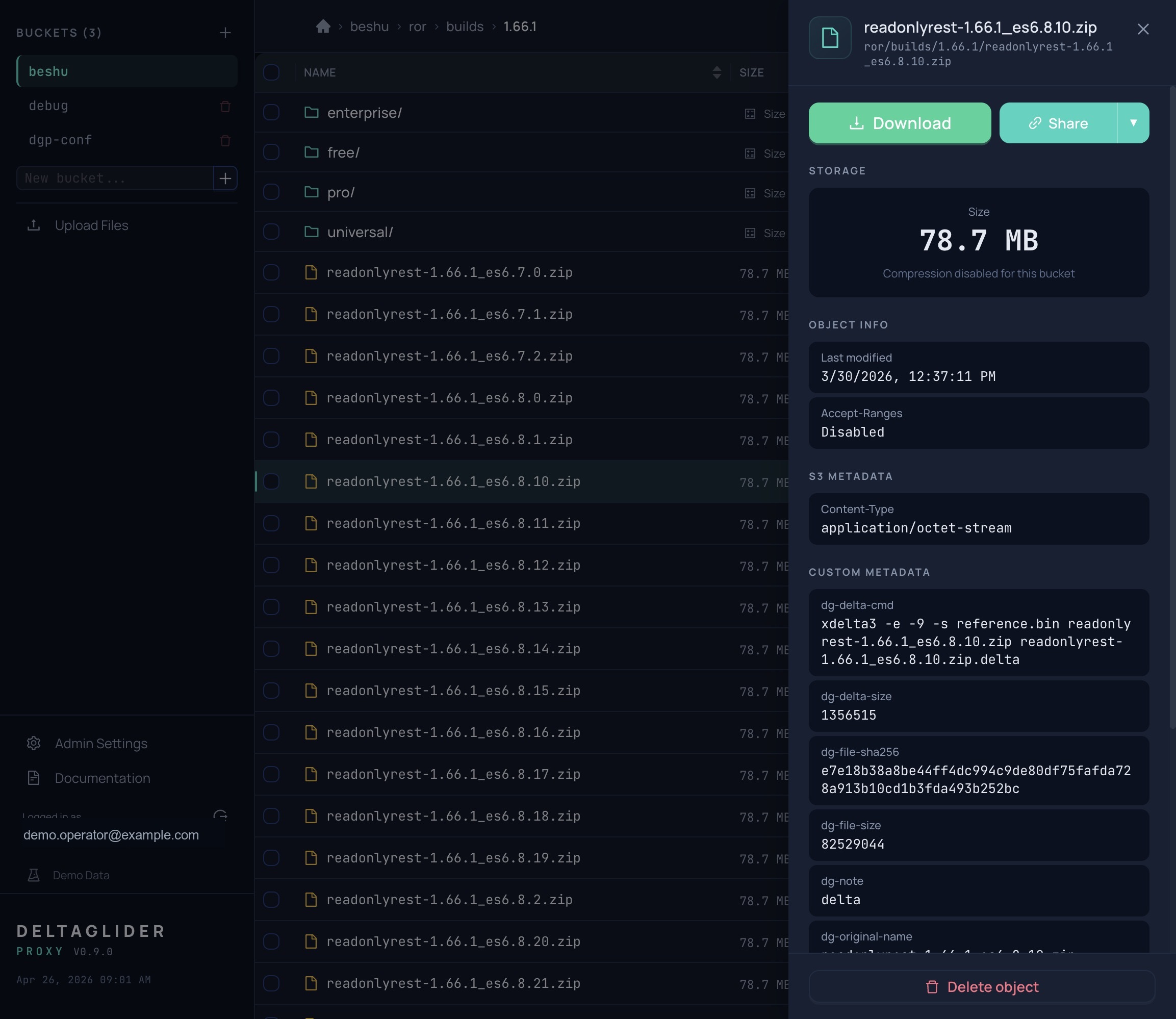
When binary-similar objects are stored over many versions — backup archives, software catalogs, game builds, texture packs, AI model variants, DB dumps, tar archives — most of each new object may be identical to the previous one. DeltaGlider Proxy stores those versions as xdelta3 deltas against a reference baseline, typically cutting storage 60–95% on high-similarity workloads without changing anything on the client side.
Clients see a standard S3 API. Delta compression, reconstruction, integrity verification, optional proxy-side encryption, and backend routing are invisible to them.
What's here
These docs are operator-facing — everything you need to install, secure, run, and debug the proxy. Developer-facing docs (build from source, release process, CI infrastructure) live on the GitHub repo rather than in the binary.
Start here
- Quickstart — install, first run, first upload.
- Setting up a bucket — backend routing, aliases, public prefixes, per-bucket compression, soft quotas.
Deploy to production
- Production deployment — TLS, reverse proxy, cache sizing, backups, multi-instance sync.
- Security checklist — SigV4, bootstrap password, IAM users, rate limiting.
- Upgrade guide — standard upgrade workflow and the TOML → YAML migration.
Authentication & access
- OAuth / OIDC setup — Google, Okta, Azure AD, generic OIDC. Single sign-on + group mapping.
- SigV4 and IAM users — per-user credentials with ABAC permissions.
- IAM conditions — source-IP restrictions, prefix scoping, group policies.
- Rate limiting — per-IP throttling, progressive delay, lockout model.
Day 2 operations
- Monitoring and alerts — Prometheus scrape, Grafana panels, alerting rules.
- Troubleshooting — common symptoms → fixes.
- FAQ — quick answers to common questions.
- Lazy bucket replication — run-now source → destination object replication through the engine, with scheduler state ready for automatic ticks.
Reference
- Configuration reference — every YAML field and env var.
- Admin API reference — every
/_/api/admin/*endpoint. - Authentication reference — conceptual model, error codes, claim shapes.
- Metrics reference — every Prometheus metric and label.
- Replication reference — rule shape, run-now controls, delete replication, runtime state.
- How delta works — on-disk layout, PUT/GET flow, integrity guarantees.
- Encryption at rest — AES-256-GCM for stored objects, chunked streaming wire format, operational caveats.
Operator summary
Shape
- Single-process Rust binary.
- S3 API on
/; admin UI and admin APIs on/_/. - Same-port deployment with embedded UI (
rust-embed) and embedded product docs. - Backend can be filesystem, AWS S3, or any S3-compatible provider: Hetzner, Backblaze, Wasabi, R2, MinIO, or lower-cost S3 SaaS.
Storage path
- Transparent xdelta3 compression for repeated binaries.
- Byte-identical reconstruction on read.
- SHA-256 verification for reconstructed objects.
- Optional proxy-side AES-256-GCM encryption keeps keys in your environment before bytes land in cheap or untrusted storage.
Control plane
- SigV4 for S3 clients:
aws-cli,boto3, Terraform, rclone. - OAuth/OIDC for admin UI access.
- Per-user ABAC permissions with IP and prefix conditions.
- Soft bucket quotas, bucket freeze, and object replication with delete replication.
- Prometheus metrics, in-memory audit ring, encrypted IAM DB, and optional multi-instance config sync.